
The Consequences of Missing Teeth – Shocking!
Missing teeth can also alter the proportions of the face... making it look "older.".
We'll save you from these problems!
What if only one tooth is missing? What if there are more?
Immediate Problems
– The chewing surfaces of the extracted tooth and its opposite (antagonist) tooth are no longer involved in the chewing process, so the food will not be chewed sufficiently
– The atrophy of the so-called gingival papilla (gingival tubercle, gingival ridge) that fills the interdental space, along with the underlying bone tissue. If an implant or dental prosthesis is placed there later, this gum and bone tissue will no longer be present, or it can only be replaced through complex surgical procedures. A future dental restoration will not look aesthetically pleasing; furthermore, food and plaque accumulate in the gap between the tooth and the restoration (see black arrow), making it difficult to clean > bad breath, tooth decay, periodontal disease… (the The gingival papilla can be preserved using an implant that is placed immediately upon tooth extraction and immediately loaded with a temporary crown).
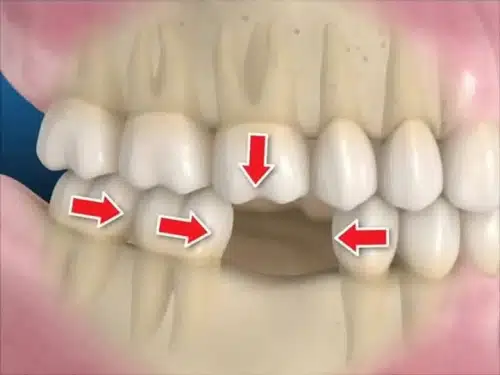
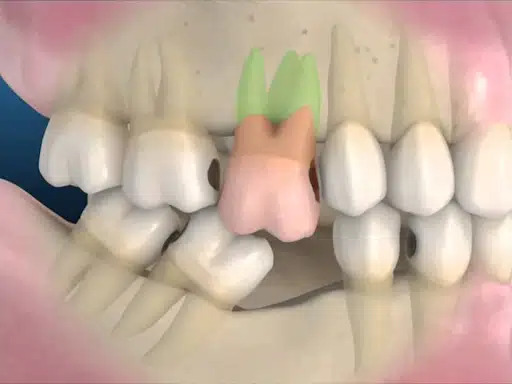

„Moderate,” slowly emerging consequences
– The tooth in front of the missing tooth shifts backward > food gets trapped in the gap between the teeth that are moving apart, leading to tooth decay, gum recession, and periodontal disease. Over the course of several years, the contact point system can become so loose—even from the loss of just one tooth—that gaps open up between the teeth on the opposite side as well.
– The teeth behind the gap tilt forward. As they press against the gums, a gum pocket—and almost always a bone pocket—forms in front of them.
– The tooth opposite the missing tooth protrudes and grows out of the bone > which also causes systemic loosening at the contact points. It continues to grow until we prevent this with a dental prosthesis. In rare cases, the bone grows along with the tooth, altering the shape of the bone.
– After the removal of the upper molars, the natural expansion of the maxillary sinus „erodes” the bone from above > bone grafting.
We'll respond within 1 business day—by phone, email, or in person
* For 3 or more implants, the cost of the consultation and CT scan is included in the treatment fee
Missing several, many teeth
– The back molars ensure the ideal distance between the upper and lower jaws. If several are missing—or if even a single missing tooth causes the last 1–2 molars to tilt forward—they can no longer maintain the proper distance between the two jaws, which move closer together due to the pulling force of the chewing muscles. The muscle shortens, and this condition becomes permanent over time. This often causes spasmodic nighttime clenching and teeth grinding… which, in a vicious cycle, further accelerates the convergence of the jawbones, exacerbating bruxism. As a result, the cartilage disc in the temporomandibular joint—similar to that in the spine—thins, develops holes, pops out (clicking jaw!), or is absorbed.
– Bones and muscles form a finely tuned, active skeletal structure: changes in muscle strength, movements, and lever arms result in bone remodeling in the face. Irreversible jaw deformities develop over the years.
– Due to missing teeth, the remaining teeth must not only cope with their original chewing force but also with the significantly increased chewing load caused by bruxism: the remaining teeth begin to wear down rapidly.
– As a result of these forces, the lower front teeth are pushed in, while the upper ones are often knocked out. A deep bite develops or worsens—the two bones now come closer together even in the front section.
– Abnormalities in the masticatory muscles and temporomandibular joint can affect the function of muscles farther away from the masticatory system > and may cause neck, shoulder, and back pain, as well as migraines.
– There is never any empty space in the mouth. The gaps left by missing teeth are filled—they grow into them—by the tongue, the floor of the mouth, the cheeks… and the face becomes sunken.

No one should take comfort in the fact that others are poor.
These changes almost always begin immediately in everyone. The more neglected a missing tooth is, and the later it is replaced with an implant, the more impossible it becomes to restore the original condition… and in some cases, it may never be possible.
Do you already have problems like this? You wouldn't want them to develop, would you?